Showing posts with label pie. Show all posts

Thursday, September 03, 2009

Dinner, Day 5: Pop Tart (Slab Pie)

First, I have to admit I'm cheating a little, but you should have known it was coming if you read my blog. I never blog daily. Even when it sounds like a good idea. So to prevent myself from being way behind (and move myself to only slightly behind), I'm eliminating a few dinner nights.

In the spirit of truth, however, I will fill you in on what dinners I will not be posting about: 1. Nothing. This was two nights in a row, actually, when I was feeling sick as a dog and my good husband continued to make sure the kids got random food or found some good leftovers for them. 2. Costco hot dogs. This is actually part of number 1. 3. Little Caesars. Sometimes we're just busy. This is decent, inexpensive fast food. Probably the fastest, now that they have $5 pizzas always ready to go.

I guess I just posted about those. But we're not counting them in my 14 days of meals because I don't care for them. And it's my blog, so I get to say.

So Day 5 was actually Sunday, Day 6 was Tuesday, and Day 7 is tonight (Thursday). See how it works?

Day 5 was our turn to host family dinner, a favorite of mine. Not only do I love, love, love cooking/baking/toiling in the kitchen, I love hosting. I don't know why, and I'm not going to figure that one out, but I love it. I don't put doilies on the tables and vases with flowers throughout the house, but I do vacuum. I think I just like being home, and I like other people being in my home, rather than going to them.

Anyhow.

My father-in-law took a trip to Alaska with his brothers and they caught some mighty fish – salmon and halibut, to be exact  – and he brought some to us to grill for family dinner. Mark marinated the fillets for about an hour in olive oil, salt, sliced onions, garlic, and lime zest. They were very good.

Family dinners are a little potluck, with the host choosing what to base the meal around. Since we had the fish already planned, I made ciabatta, sourdough, peach pie, and nectarine slab pie. What's slab pie, you ask? Well.

Slab pie is a pie made on a sheet pan (with edges). It contains roughly one and a half times the pie dough used for a double-crust pie with the same amount of filling. And when you drizzle a little frosting over the top, it looks very much like a large Pop Tart. Well, more like a Toaster Strudel, I guess. But it tastes a wee little bit better. At least. And it serves a large amount of people, which is a bonus. Still great with ice cream.

My sister-in-law and her husband planted a nectarine tree two or three years ago and asked me a bit ago if I could use the nectarines for pie or something. Never one to turn down free ingredients, I gladly peeled, sliced, and froze the nectarines until it was time to host dinner. Their generosity was a benefit to me: I wouldn't have tried using nectarines otherwise, and I think they may be one of the best fruits for slab pie. They formed a dense, smooth, soft filling, rich in flavor, that was a nice center for such a thin pie.

Let's talk about the crust for just a minute. It's important that you still use the very best crust for this dessert, as the crust is even more predominant than in a regular pie, but keep in mind that you will need to roll it out until it is quite thin, thinner than a regular pie. This is probably the most difficult part of putting the dessert together, but it's not rocket science. Just take your time and be mindful of trying to make a rectangular shape.

My half sheet pan that I used is about 17" x 12", or perhaps just a bit more, with sides that are about 1/2" high. This recipe should work for any pan that is no larger than this size and any pan that is smaller. If you're only going to make a 9" x 13" pan, you'll want to cut back on the pie dough and a third of the filling.

I lined my baking sheet with parchment paper to be sure I could easily remove all the pie pieces. That part is optional but recommended.

I also think this recipe would be terrific with apples. No matter what fruit you use, it really looks perfectly created for breakfast.


Nectarine Slab Pie

for the dough (adapted from Sherry Yard):
3/4 lb. (3 sticks) cold unsalted butter
3 3/4 c. all-purpose flour
3 T. sugar
1 1/2 t. salt (table, or finely ground Kosher)
3/4 c. ice water
3/4 t. white wine vinegar
 
Filling:
6 c. peeled, sliced nectarines
3/4 c. sugar
1/4 c. flour

Topping:
2 c. powdered sugar
3 T. milk
1 T. fresh lemon juice


For the dough:
Cut the butter into 1" pieces and place in the freezer for 15 minutes (no more).

In a stand mixer with the paddle attachment, mix the flour and sugar. This lightens the flour to make the dough more tender. Add the butter and salt. Mix on low speed for at least 30 seconds and no more than 2 minutes, until most of the butter is about the size of walnut halves. Stop the machine and pinch all the large pieces of butter flat. Be careful not to just mash the pieces; the goal is to create flat, flaky layers in your dough.

Combine the ice water and vinegar, then add the liquid all at once to the flour mixture. Blend for no more than 15 seconds, until much of it is just coming together.

Spread out two sheets of plastic wrap. Bring the dough together just a bit with your hands, just enough so that it's not all crumbs, but do not work it much at this point, as working the dough while it's slightly warm from this process will damage the layers of flakiness and cause the dough to be tough. Divide the dough into two rounds, one larger by about 25%. Wrap in plastic and square off the edges. Refrigerate for at least 15 minutes. If you refrigerate it an hour or more, let it set at room temperature for a few minutes before rolling out. 
 
Just before rolling out the dough, prepare the fruit and set aside.

Preheat the oven to 400˚.  Line your baking sheet with parchment paper if desired.

On a well-floured surface, heavily dust both sides of the larger piece of pie dough and roll into a rectangle slightly longer and wider than your baking sheet. Be sure to dust the dough with flour a few times, brush the flour around, and flip the dough over to be sure it doesn't stick to the work surface. Once it is large enough to fill the sheet, come up the edge, and lean over the edge enough to crimp later, fold it in half and transfer it to the pan. Then unfold. 

Roll out the top dough. Fill the bottom dough with the nectarine filling, making sure you get all of the extra juice into the dough. Top with second rolled dough and crimp edges.

Bake at 400˚ until golden brown, about 45 minutes. Since the filling is thin, it will be done as soon as the crust is done. You can reduce the oven temperature to 375˚ if you feel the crust is browning too quickly. Remove from the oven to a cooling rack.

Stir together the confectioner's sugar, milk, and lemon juice. If it needs to be thinned a bit more, you can add a little more milk or lemon juice. Drizzle over the slab pie.

Let cool. Slice into 20 pieces. Serve slightly warm or at room temperature. 


Thursday, August 20, 2009

Pie Night


The other night we had a little (sort of) get together with a few friends, mainly to celebrate (or lament?) the end of the biking season, though we've still got Lotoja to go.

I loved the evening because it was nice to hang out and relax with all of our friends we've made through Mark's hobbies, and it was great to serve pie. Don't get me wrong. I love eating pie, too, but – if I had to choose – I would pick making and serving pie over eating it any day.

We had a really difficult time limiting the number of people we invited, which is always a real issue for us, since we would prefer to have an open invitation and let everyone show up, but we don't have that kind of space. Instead, we chose a very crowded amount we thought we could manage and most of them were able to come, fortunately.

That meant we needed a lot of pies. A couple of friends brought cookies (which were really, really delicious). Holly volunteered to make two peach pies and Gina lent me two pie dishes. It was also my brother-in-law's birthday, and he requested pecan pie. I can't make a lot of pie without making chocolate cream, so I made 2 of those, 2 pecan, 3 blueberry, and 1 peach, bringing us to 10 pies with Holly's contribution. But then I had one more pie dish sitting in my cupboard and two boxes of peaches waiting to be frozen and canned, calling out to me. I gave in and threw another peach pie in the oven last minute. As busy as I was, I loved making the pies. It may be my favorite thing to make. I could make them forever.

Even better than making pies, though, was hanging back and watching everyone chat and eat, knowing they were happy to be here. I really like all the friends we've made here, and it was comforting to me to surround myself with them, since moving to a new place can potentially make you feel like you're a fish out of water for a long time. It's terribly selfish of me, really, but I feel really happy serving good food, knowing someone gets to enjoy a taste of something they'll like. I didn't even care if I ate pie that evening, which is crazy, since it was really good. Know what I mean?

I made blueberry pie for the first time ever just a few weeks ago. Not only was I surprised at how well I liked the flavor of the baked blueberries, I couldn't believe how simple it is to make. No peeling or slicing fruit. No juice streaming down the arms. And they bake a little faster than other pies, too, which is nice. This is my recipe:


Blueberry Pie

enough dough for a double crust pie (I like to do 1 1/2 batches of dough and bake the extra, just to be sure I've got plenty)

36 oz. blueberries (2 1/4 lbs.) - frozen then thawed blueberries are great, just use good quality
2/3 c. sugar
2 T. cornstarch
1 T. lime juice
1 t. cinnamon (you almost can't taste it, but it gives it a nice nuance of flavor)

Preheat the oven to 425˚.

Stir together all the pie filling ingredients.

Roll out the bottom and top crusts. Lay the bottom crust in the pan. Add the filling. Top with the top crust. Trim edges, press together, and crimp. Cut a few vent lines in the top of the pie.

Bake at 425˚ for 30 minutes, then reduce the oven temperature to 375˚ and bake until filling bubbles in the middle, topping with foil if necessary to keep the crust from burning (not always necessary). Cool on a cooling rack until room temperature. Serve with vanilla ice cream.

Wednesday, November 26, 2008

Pumpkin Pie

I know, I know. I'm spoiling you, posting twice in two days. It's so unlike me. Well, maybe more like my old self before I was trying to sell a house and take care of the kids while my husband is in another state. But I know you can take it. And besides, this recipe is especially for me because I've nearly lost it several times and I'd have to start all over if I did, deciding what I like in a good pumpkin pie.

I like my pumpkin pie to be pretty traditional, but smooth and creamy (it is a custard, after all). And I don't mind a little zip or zing to go with the spices, so I substitute crystallized ginger (sometimes called candied ginger) for powdered ginger. I also love it in my chewy molasses cookies which I've also never posted (maybe I'll take care of that in the next couple of weeks). It's a little punchy, but still sweet and not too crazy. If I'm making the pumpkin pie for a large gathering with lots of children (typical), I chop the ginger up really finely, into little bits, and then it's not too strong for them. You can find crystallized ginger in the Asian section of the supermarket, in a little box. Or in a bulk spices section, if you're lucky.

I came up with this recipe about 6 or 7 years ago, and I've never varied from it until this year. It's always been a deep dish recipe, but my husband and I decided last year we prefer pumpkin pie not to be deep dish. Yes, it took us a long time to figure that out, but it's the only pie I would say that about, so you'll have to forgive me.

Here's the recipe, and I'll post a picture after I bake it. Sorry! You'll have to wait.

For a printable version of this recipe, click here.


Pumpkin Pie

1 unbaked pie shell (recipe here)
1 3/4 c. pumpkin purée (canned is great, fresh is great if you press the juice out)
3 large eggs, lightly beaten
3/4 c. cream
1/2 c. dark brown sugar
1/4 t. allspice (freshly ground if possible)
3/4 t. cinnamon
1/2 t. ground ginger
1 1/2 T. crystallized ginger, chopped (optional)
1/4 t. salt

Preheat the oven to 375˚. Line a 9" or 10" pie dish with the pastry. Make some pastry leaves with the remaining dough. You can place these around the edge of the pie now or bake them separately to garnish later (just a few in the middle). Chill the pastry while preparing the filling.

Combine the pumpkin with all remaining ingredient and mix thoroughly. pour into the prepared crust and and bake for 50-75 minutes, until the crust is nicely browned and the custard is set (it will jiggle like jell-o, not like liquid). A toothpick should come out clean halfway to the center of the pie. If the crust browns too quickly make a ring of aluminum foil to protect it during baking. Bake the individual leaves for about 15 minutes. Cool pie and leaves. Refrigerate pie to chill completely.

Garnish with pastry leaves. Serve with lightly sweetened (about 2 T. sugar per 1 c. cream) whipped cream.

Monday, June 16, 2008

Dark Chocolate Cream Pie


It is with great pleasure I announce that my most recent pre-baked pie shell was successful. As I've mentioned previously, blind baking has never been my forte. Making pies, however, is one of my favorite kitchen tasks, so I have welcomed the challenge. Since I last posted, I've studied up, listened to advice, and experimented. And, as you can see above, I did pretty well. There was just a touch of shrinkage, but I'm still calling this a success.

So, here's the first step to this great pie:


Blind-Baked Pie Shell

First, make the pie dough (recipe here), roll it out, and shape it in a pie dish. Then refrigerate the dough for at least 30 minutes. This gives the elastic properties in the dough time to relax in the shape you've set it in, so it doesn't want to spring back. Next, place the pie dish in the freezer. I used my deep freezer and had it in there 20 minutes. If you're using a kitchen freezer, go for 30. Line the pie with aluminum foil (this takes two regular-width sheets, perpendicular), then fill the pie one-fourth of the way up with pie weights or dry beans. Don't add more weights than this, or the crust will not bake quickly enough, as they'll pull heat away from the crust. Also, the weights are a benefit to the bottom crust and won't hold up the sides, really, so you don't need a ton of them to do the job. (By the way, I use beans.)

Bake the pie crust in a 450˚ oven for 20 minutes. Remove the weights and foil from the crust, reduce the oven temperature to 375˚, and bake about 15 minutes more, checking after 10, until the crust is perfectly baked. Remove from the oven and cool completely before filling.

Sherry Yard, pastry chef to Wolfgang Puck and author of The Secrets of Baking, says that it's necessary to start the pastry baking at a very high temperature to encourage steaming between the layers of fat and starch right away; otherwise you're just melting the butter first, which will slacken the dough. Because the dough is frozen before baking, I increased the temperature from the usual 425˚ to 450˚, especially since my previous attempt to start at 425˚ didn't work well. Also, I baked it at this higher temperature for a full 20 minutes. It certainly wasn't going to burn, and I wanted the sides to set up really well. I definitely wouldn't go less than 20 minutes unless you're baking in a thin metal pan, and then you might stop at 17 or 18.


Now, onto the reason I was doing this in the first place. Chocolate.

Of all the cream pies, chocolate has to be my favorite. I think. They're all good, actually. Especially banana. But chocolate tops them all when the chocolate filling is just right: decadent, smooth, and firm when set up. You should already know I don't like wimpy chocolate, so trust me on the depth of flavor here. And if you're not sure how dark you like your chocolate, just add more whipped cream to the top of the pie. Or you could substitute bittersweet chocolate for the small amount of unsweetened chocolate. But please don't. Just make the pie like it is, and enjoy it. But leave some leftovers. Like all chocolate desserts, it's even better the next day.


Chocolate Cream Pie
ever so slightly modified from a Bon Appétit recipe, Black-bottom Chocolate Pie


Filling:
2/3 c. sugar
1/4 c. cornstarch
2 T. unsweetened cocoa powder
pinch salt
6 large egg yolks
2 c. milk
1/2 c. heavy or whipping cream
5 1/2 oz. bittersweet chocolate, chopped
1 oz. unsweetened chocolate, chopped
1 1/2 t. vanilla extract
2 T. unsalted butter

one baked, cooled 9" pie shell

Topping:
1 1/2 c. chilled heavy or whipping cream
3-4 T. granulated sugar
1 t. vanilla extract

chocolate curls, for garnish

For the filling, whisk the sugar, cornstarch, cocoa, and salt in a heavy medium saucepan. Stir in the yolks until evenly combined. Whisk in the milk, then the cream. Set the saucepan over medium to medium-high heat, whisking constantly, until it starts to get pretty warm. Reduce the heat to medium-low and continue whisking until the mixture thickens and simmers (a full boil isn't necessary) for one minute.

Remove from heat. Add the chocolate and whisk until smooth. Stir in the butter and vanilla until the butter is melted. Pour into a medium bowl. Set the bowl inside another bowl made into an ice bath (ice and water) and stir frequently for about 20 minutes to cool.

Pour the filling into the prebaked pie shell and chill for at least 2 hours, preferably 4.

Whip the cream, sugar, and vanilla until medium to firm peaks form. Top the chocolate pie and garnish with chocolate curls. Keep chilled when not serving.

When I served this the first day, I was anxious, so it wasn't a really solid filling, but by the next day it cut nicely and held its shape well. Even if you ice bath the filling for 30 or 40 minutes, it will still need a couple of hours to chill completely in the refrigerator before serving.

Tuesday, April 22, 2008

Nearly Perfect Pecan Pie

If you read my previous post on pecan pie, you know I've been trying to perfect the recipe for some time. Quite some time. In general, I'm very critical about my own food (and much less so of others), but that's only because I'm trying to learn to get things just right. And, frequently, I do get things just right, at least for me. We all of our own preferences. For example, I wouldn't change anything about my granola, carrot soup, roasted garlic soup, carne asada, M'n'M cake, or chocolate chunk cookies. Most other things may change a bit, depending on the day.

The pecan pie has slowly been evolving. It has gone from good to better to very good indeed. The funny thing is that the original recipe was from a Cooking Light magazine, though it hardly resembles that rendition now. Theirs was good, but why make a light pecan pie? And, in fact, the secret to their "light" pie was that it was about half the filling. So a slice would have half the calories and be half as tall. Portion control is an important aspect of food consumption, so I'm not against the trickery, but I wasn't fooled.

You may be wondering why the title is "nearly perfect" rather than "perfect". Or maybe not. In any case, it's the crust that's at fault. My darn crust always shrinks up. I'm sure it's because I use an all-butter crust. I even tried chilling it for 45 minutes before baking it, a suggestion from Cook's Illustrated, but to no avail. It doesn't shrink below the filling, though, because the filling holds it up if it falls that much. If I ever fix this problem I'll let you know. But I won't be fixing it by substituting anything for butter. I love my butter crust too much. Have you tried it? I mentioned it before with the peach pie, but I'll add it below again.

At last, I'm willing to share the recipe. So many hours of labor went into it, so if you make it, follow the recipe carefully and you should be happy. And if not, you should be nearly happy.


Pecan Pie

1 9" deep-dish unbaked pie shell (recipe follows)
6 large eggs
2 c. light corn syrup
1 1/3 c. dark brown sugar
9 T. butter
1/4 t. salt
3 c. pecan halves, toasted at 350˚ for 8-10 minutes, cooled
1 1/2 t. vanilla extract

Preheat the oven to 350˚.

In a medium saucepan, stir together the corn syrup, brown sugar, salt, and butter over medium heat. Bring to a boil and boil for 1-2 minutes, stirring constantly. Pour out of saucepan into a bowl and cool by stirring over a water bath or setting in the refrigerator and stirring occasionally, until just a bit warm. (Until it's cool enough to add eggs without any danger of cooking them prematurely. This also provides a good opportunity to roll out your pie dough.)

Whisk the eggs until smooth and consistent. Whisk in the vanilla. Stir the eggs into the caramel. Stir in the pecans. Pour into the pie shell. Bake for about 30 minutes, then cover it with foil to prevent the crust from browning too much. Continue to bake another 40-50 minutes, until the center of the pie is well set. This is difficult to figure out...if it's sufficiently baked. With a deep dish pecan pie, it's going to take a while, but it shouldn't be in the oven more than 90 minutes. 75-80 should be about right, unless your dish is shallower.

Remove to a cooling rack and cool to room temperature, then chill before serving. I prefer to serve pecan pie at about 50˚-60˚, so if it's not cold enough in your garage to chill it there, chill it in the refrigerator and let it set at room temperature for 30-60 minutes before serving.

Serve with lightly sweetened whipped cream: about 2 c. cream, 3 T. granulated sugar, and 1/2 t. vanilla, whipped to soft or medium peaks.


Pie Dough
adapted from The Secrets of Baking by Sherry Yard
makes 2 crusts

1/2 lb. (2 sticks) cold unsalted butter
2 1/2 c. all-purpose flour
2 T. sugar
1 t. salt (table, or finely ground Kosher)
1/2 c. ice water
1/2 t. white wine vinegar

Cut the butter into 1" pieces and place in the freezer for 15 minutes (no more).

In a stand mixer with the paddle attachment, mix the flour and sugar. This lightens the flour to make the dough more tender. Add the butter and salt. Mix on low speed for at least 30 seconds and no more than 2 minutes, until most of the butter is about the size of walnut halves. Stop the machine and pinch all the large pieces of butter flat. Be careful not to just mash the pieces; the goal is to create flat, flaky layers in your dough.

Combine the ice water and vinegar, then add the liquid all at once to the flour mixture. Blend for no more than 15 seconds, until much of it is just coming together.

Spread out two sheets of plastic wrap. Bring the dough together just a bit with your hands, just enough so that it's not all crumbs, but do not work it much at this point, as working the dough while it's slightly warm from this process will damage the layers of flakiness and cause the dough to be tough. Divide the dough a little unevenly into two lumps and wrap each in plastic. Refrigerate for at least 15 minutes. If you refrigerate it an hour or more, let it set at room temperature for a few minutes before rolling out. Also, before you remove it from the plastic, make sure each lump of dough is shaped into a nice round, semi-flat disc. This will help you in the rolling-out process.

To roll it out,
I highly recommend using a French rolling pin, as it's more easily controlled and lightweight enough to avoid mashing the dough, which is not what you want. Lightly flour a work surface, then dust both sides of your disc with flour. Begin rolling out your dough, taking turns which direction your are rolling. You should go in all directions, and you should dust the top of your dough with flour and turn it over once or twice during this process, so that it doesn't stick to the work surface or get unwanted clumps of flour in spots underneath. Feel free to use lots of flour while rolling out your dough; just be sure it's evenly used across the circle.

Tuesday, November 13, 2007

Pecan Pie


I love pecan pie.

This is interesting, because I couldn't stand pecan pie when I was little. It wasn't until I married Mark that I learned pecan pie is supposed to be soft, rich, and caramely rather than dry, overbaked, and flavorless. It's actually Mark's favorite pie, and if it hadn't been, I probably wouldn't have taken so much time to perfect it. He chose it as his birthday dessert, because as much as he loves a really good chocolate cake, he loves good pecan pie more.

Sunday, I worked on refining the recipe. In 4-oz. ramekins, I made 6 variations of pecan pie fillings, varying the type and quality of sugar, the amount of butter, and the eggs. We tasted each of them and to our great surprise preferred more butter over less and more expensive, unrefined sugar to ye olde C&H golden brown. Okay, not to our great surprise.

I'll tell you what I know about good pecan pie. Toasted pecans are better than raw pecans. Overbaked pie is dry and certainly not worth the calories (because, in case you're wondering, it does have at least a few calories). You need to prick your crust before adding the filling. It should be served cold, though for most pies I prefer room temperature since the crust is more flavorful that way. It should be served in small slices since it's very rich. It's best with whipped cream, but also good by itself. I should not be left alone for a whole day with the leftovers and be expected to save a piece for someone else. And, of course, you need to start with a fabulous crust, which I already have.

So, what is the perfect pecan pie recipe? Well, I don't exactly know yet, but I'm very close. I would say very, very close. So close I can taste it.

Thursday, October 04, 2007

Chicken Pot Pie

Let me extol the virtues of chicken pot pie. First, the crust. How ingenious is it to use pie crust in savory dishes, so you don't even have to wait for dessert. Of course, that's assuming you've had good pie crust and know what you're constantly missing out on everyday there's not a pie waiting for dessert.

Second, who doesn't like stew in cold fall temperatures? That starchy, mellow goodness that warms your whole body and satisfies every bit of your hunger. It just feels like you're home when you're eating a stew.

And third, it's a one-dish meal. Kind of. It actually takes a few dishes to prepare it, but you only need to put one serving dish on the table when you're sitting down to eat. Everyone gets some protein, everyone gets a few vegetables, and everyone gets a little incentive to eat the dish, since it's topped with a delicious homemade crust.

Okay, now I'll tell you what I really think, usually, of pot pie. All the ingredients taste pretty good, but then you stick them all together and there are no clean flavors left. The result is that harmony of nothingness. Creamy, stewy, whatever. I like making chicken pot pie, but by the time I serve it, I don't want another bite. I'm over-stewed. Except this time.

One of the problems is that nothing has any distinct flavors in a stew. This is really okay, but to make it interesting, you can't just add all your average components and expect to have an above-average flavor in the end. You also can't add exciting flavors and expect them to stand out above everything else; well, if you add a whole lot of them, they will, but the pie will be best when you have achieved a good balance of complementary flavors.

I like mushrooms in my pot pie, and I like the way that Sherry tastes with mushrooms. I prefer crimini to white mushrooms because they have an earthier flavor. That was a good starting point for me. I considered the rest of the basics: shallots over onions and/or garlic, red potatoes (definitely) boiled or fried, how much chicken, roasted or poached, and seasoning.

I thought shallots would make a difference here, since I didn't want onions or garlic taking over the flavor of the dish. Boiled potatoes, a very watery starch, would only dilute the other tastes and textures, but frying the potatoes in an oil-free non-stick skillet would not only give the potatoes texture, but also enrich the flavor of the rest of the dish. However, I thought the more delicate texture and flavor of poached would make a better meal. I'm not crazy about overdoing the chicken flavor in chicken pot pie, which I guess sounds really ironic.

As far as other flavors go, I decided to start with bacon to give it a little smokiness, which really mellowed out by the end, but I'm happy with the amount I had. You could opt for more if you want that flavor to stand out, but as I've said, it's not about anything standing out, but coming together. I also added an apple and a touch of Dijon for just a bit of acidity to balance everything else out. Now, you might think, "Oh, yum, this recipe sounds really good, but I think I'll leave out the Dijon. I'm not crazy about that part." At least, if you're like me, you'll be thinking of how to alter the recipe before you start. Don't leave out the Dijon. There's just a teensy weensy bit in there, and it's so perfectly a part of it. Don't leave it out. I'm not kidding. Just leave it in. Please. You'll be so happy you did when you taste it, except you won't really taste much of it at all, and it will be just right, and you'll realize how absolutely brilliant I am. And that I'm always right.

Of course, the crust is extraordinarily important, so make your crust. It doesn't take long, and you can just quickly use your fingers to smash the mixture to pieces if you don't have a stand mixer, but an all-butter crust will make the dish, since butter goes so well with stew, but shortening does not. Oh, and also (which is a phrase I think my daughter uses), I only make a top crust, since otherwise it's not so much about making a dinner as it is about eating crust.

This was so good that I thoroughly enjoyed my dinner, even after tasting everything so much along the way. In fact, I wanted to eat a lot more, but, well, it's not the healthiest meal out there. But it is delicious. (Do I sound torn? I was very torn.)

By the way, this does fit in with my diet. It's all about portion control, after all. And exercising 60 minutes today. And having nothing else but V8 the rest of the day (I'm drinking one right now and it's delicious). See, I can make it work.


Chicken Pot Pie
makes 2 pies (one for you, one for me)

1/2 lb. bacon, chopped (I prefer thick, maple-cured bacon)
1 lb. shallots, sliced
2/3 lb. crimini mushrooms, chopped
1 lg. apple, diced (I used Honey Crisp, but any would be fine)
2 1/2 lbs. red potatoes, 1/2" dice
2 large chicken breasts (about 1 1/4 lbs.)
2 T. butter
1/3 c. flour
1/4 c. sherry
3 c. chicken broth
3 T. cream (because I had it around, milk would be fine)
1 t. Dijon mustard
1 c. peas
Kosher salt
freshly ground black pepper
One recipe pie dough, divided into two equal portions, rolled out (you can roll them out, wrap them in plastic wrap, and set them in the fridge while you do all this)

First, poach the chicken. In a small or medium saucepan, add water to about 3 inches, the core from the apple you diced, a few baby carrots, and 1/2 t. salt. Add the two chicken breasts, set over medium heat, and bring nearly to a simmer. Reduce the heat to medium-low and cook for 15 - 20 minutes. Remove from the heat and let the chicken sit in the poaching liquid for another 15 minutes or so, cooling, until you're ready to cut it up.

In a large non-stick skillet, set the bacon over medium heat and cook, stirring occasionally, until done. Remove to drain on paper towel, then pour off all but 4 T. of the bacon grease. You can eyeball this. If you're concerned about saturated fat, keep the bacon but substitute olive oil for the bacon grease.

Turn the heat up to medium-high, then add the shallots with a few pinches of salt. Cook, stirring, until they're nice and soft, then add the mushrooms.

(Just a note here, in case you haven't heard this already: it's important to salt food as you make it, in the layers that you're putting it together, to bring out the flavor of each layer. Also, sometimes it's important to draw out the liquids in each food to help them cook faster, as with onions, mushrooms, and potatoes.)

Cook the shallots and mushrooms until the mushrooms are starting to brown a bit and have given off a lot of their liquid. Add the bacon and apple, stir a few times, and remove to a bowl for later.

Preheat the oven to 400°.

To your skillet, add the potatoes and about a teaspoon of salt. Cook, stirring, covering with the lid for a minute or two here and there to help them along (this will steam them a bit, then they'll dry out after the lid is removed, which helps them to cook without browning too much), adding a bit more salt here and there as needed for taste and to draw out more liquid. If they seem to be browning quickly, turn the heat down to medium and keep stirring. This takes about 20 minutes. Remove the potatoes to a large bowl.

Dice the chicken into 1/2" cubes.

Add the mushroom mixture back to the skillet along with the 2 T. butter. After that has melted, stir in the flour completely, then stir in the sherry. After cooking for a few seconds, add the broth, cream, peas, and chicken. Bring to a simmer, where it should thicken up a bit. Taste and season with salt and pepper. Stir in the Dijon. Add the whole mixture to the bowl of potatoes and stir.

Divide the stew between two pie pans and top each with the pie dough. Cut a couple of slits in the top. Bake for 20-30 minutes, until the crust is just done. Cool 10 minutes and serve.


Now, doesn't that sound easy?

Thursday, August 23, 2007

Peach Pie


Peach pie is one of those lovely little treats that remind me why I love food. Not that I needed reminding. When the crust is flaky and delicate, the peaches are sweet and fresh, and the ice cream is vanilla and nearby, everything seems to come together to create the perfect blend of flavors in your mouth. Maybe I like it so much because I can remember eating my mom's peach pies so many times the first 18 years of my life, or maybe my mom made it so much because she knew it was a good thing, too.

Good pie starts with a good crust, which may seem difficult to come by, but is not that difficult to accomplish. I could probably write for three days on all my experiments with pie crust and not cover half of the information out there, but I'll save you the trouble and just include the good stuff. Crust is important. If you aren't going to make a good crust, then don't waste your time - make a cobbler. Cobbler topping recipes are even easier than pie crust recipes, and clearly your goal is to get to the filling anyhow. Still, you should reconsider.

I like an all-butter crust. The flavor is unbeatable, and if you can get it really flaky, it is one of the finest pastries around. Some people prefer to use part vegetable shortening with their butter crust to make rolling it out easier, but when this recipe is done right, the all-butter crust rolls out quickly and smoothly. I've tried using a pastry cutter, forks, fingers, and a food processor, but my favorite method (by far) is from Sherry Yard in The Secrets of Baking, which is where this crust recipe originates. (I highly recommend the entire book, though!) Please, do not use salted butter in this recipe. It will not produce the same quality in flavor.

By the way, if you need to purchase a stand mixer for this recipe, I recommend KitchenAid, and you should get it here.

Pie Dough
adapted from The Secrets of Baking by Sherry Yard

1/2 lb. (2 sticks) cold unsalted butter
2 1/2 c. all-purpose flour
2 T. sugar
1 t. salt (table, or finely ground Kosher)
1/2 c. ice water
1/2 t. white wine vinegar

Cut the butter into 1" pieces and place in the freezer for 15 minutes (no more).

In a stand mixer with the paddle attachment, mix the flour and sugar. This lightens the flour to make the dough more tender. Add the butter and salt. Mix on low speed for at least 30 seconds and no more than 2 minutes, until most of the butter is about the size of walnut halves. Stop the machine and pinch all the large pieces of butter flat. Be careful not to just mash the pieces; the goal is to create flat, flaky layers in your dough.

Combine the ice water and vinegar, then add the liquid all at once to the flour mixture. Blend for no more than 15 seconds, until much of it is just coming together.
Spread out two sheets of plastic wrap. Bring the dough together just a bit with your hands, just enough so that it's not all crumbs, but do not work it much at this point, as working the dough while it's slightly warm from this process will damage the layers of flakiness and cause the dough to be tough. Divide the dough a little unevenly into two lumps and wrap each in plastic. Refrigerate for at least 15 minutes. If you refrigerate it an hour or more, let it set at room temperature for a few minutes before rolling out. Also, before you remove it from the plastic, make sure each lump of dough is shaped into a nice round, semi-flat disc. This will help you in the rolling-out process.

Peach Pie

For the filling, you'll want between 4 and 8 cups of peeled, sliced peaches, depending on how big your pie pan is. If it's a 9" deep dish pan, as most of mine are, use about 8 cups of peaches. For a small pie pan, especially a shallow one, you may need as little as 4 cups. Unlike apple pies, you can't just mound up the fruit before baking, as it will run over. And also unlike apple pies, peach pies are better without additional flavorings, as long as you have good, ripe fruit. Save the cinnamon for your apple pies, and leave the almond extract out (unless you're my mom, in which case you have the good sense to do whatever you want). For each cup of sliced peaches, add 1/4 c. of sugar and 1 1/2 T. of flour or 1 1/4 T. cornstarch (I prefer cornstarch by far with peach pie, as it requires a generous amount of thickening agent). This should make the pie sweet enough and thick enough not to run all over the place, even if slightly warm.
Now that your filling is ready, it's time to roll out the dough. First, preheat the oven to 425°. I highly recommend using a French rolling pin, as it's more easily controlled and lightweight enough to avoid mashing the dough, which is not what you want. Lightly flour a work surface, then dust both sides of your disc with flour. Begin rolling out your dough, taking turns which direction your are rolling. You should go in all directions, and you should dust the top of your dough with flour and turn it over once or twice during this process, so that it doesn't stick to the work surface or get unwanted clumps of flour in spots underneath. Feel free to use lots of flour while rolling out your dough; just be sure it's evenly used across the circle. Your bottom dough should be plenty large; the recipe should provide you with enough dough to ensure you can roll it slightly beyond what you need, so you can estimate the amount you need for the bottom, sides, and crimping the edges.
Gently place this dough in the bottom of the pie pan, then roll out the top so that it extends about an inch and a half beyond the edge of the pie pan. Use a paring knife and cut the edges of the crust all the way around just an inch or so beyond the pan, leaving a little more in especially thin sections (if you have any of those). Press the edges together, then turn the crust underneath and crimp using your thumbs and forefingers. Cut slits into the top to let the steam to escape.
Place the extra pieces of rolled dough that you cut off the edges in a small pan (I used nonstick), and dust with cinnamon and sugar. Bake alongside the pie for the first 10 minutes, or thereabouts, and remove from the oven to eat while you wait for the pie to bake.


Place the prepared pie in the oven and bake at 425° for 30 minutes, then reduce the oven temperature to 350° and bake for an additional 25-45 minutes, until the filling is bubbling near the center, as can be seen through the slits. If the crust is browning too much, cover with aluminum foil to slow it down (I do this when I turn the oven temperature down), but remove the foil during the last 5 minutes or so to make sure the crust is crisp and not steamed.

If everything went well (and I'm sure it did!), you should have a very flaky crust and one fantastic pie. Let it cool on a cooling rack nearly to room temperature, then serve with vanilla ice cream.

Tuesday, November 21, 2006

Thanksgiving Dinner

Let's be honest. Thanksgiving is about the warmth of being around family, taking time out for one another, and showing gratitude for our bounteous blessings, but - most of all - Thanksgiving is about a nice big dinner. We all love to eat, and for those of us who love to cook, Thanksgiving is paradise. That's me. I love to cook. This week is so exciting for me, with lots of family coming and tons of food to organize and prepare, that I can barely sleep. The last few mornings I've been waking up too early with that feeling inside like I got when I was little and it was Christmas day.

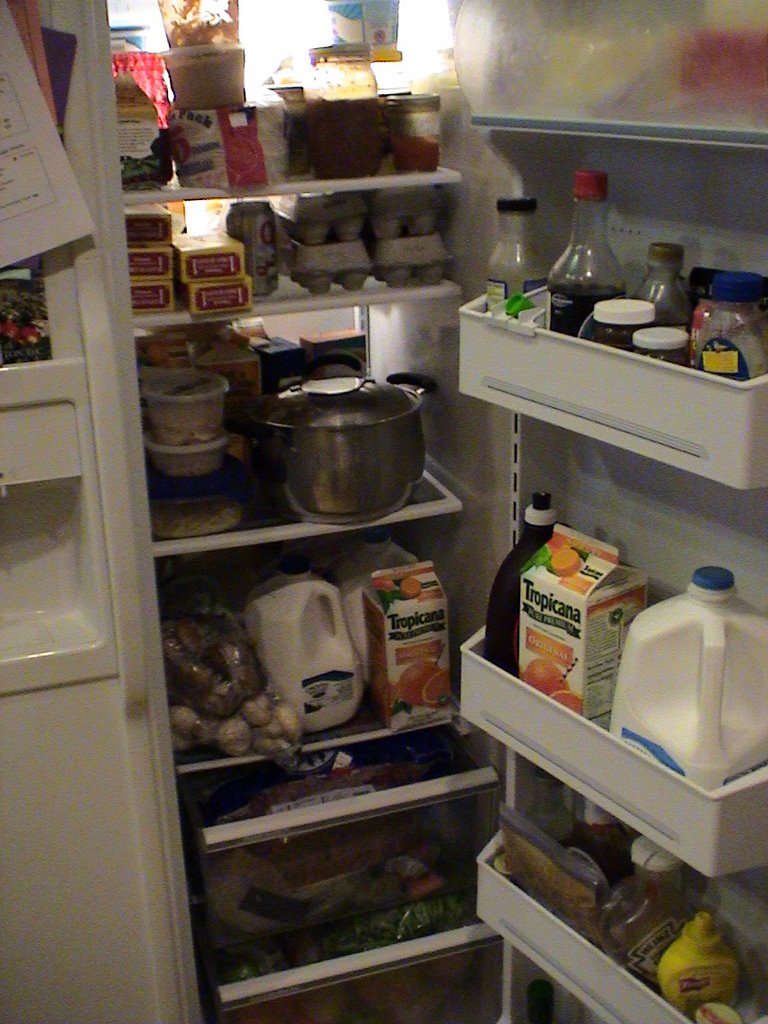
But enough about my giddiness, we have more important things to discuss, like what we're actually eating. As you can see, the refrigerator is stuffed and ready for the week. (Good thing I cleaned it last Wednesday!) So here's the menu:


Warm Pear and Pecan Salad
This may be my favorite part of the meal. I got this recipe, which I've since altered as usual, from a weekly email from The Splendid Table, which I highly recommend. In the original email, Lynne Rossetto Kasper mentioned the salad was good enough to have as a main course. I have to agree. The pears are warm, the pecans are slightly sweet and toasty, the bleu cheese (I only use Maytag) balances the flavors so well, and the cranberry vinaigrette adds just the right amount of tartness to bring it all together. It's a splendid salad, and here's the recipe:

Vinaigrette:
2 1/2 T. raspberry vinegar or red wine vinegar
1 t. - 1 T. sugar, depending on the sweetness of the vinegar
1/2 t. orange zest (microplane works best)
salt, freshly ground pepper
1/4 c. olive oil
3 T. dried, sweetened cranberries, coarsely chopped

Salad:
1 large pear, cored, sliced into 8-12 wedges
1 1/2 t. olive oil
1 1/2 t. butter
salt, freshly ground pepper
1/3 c. pecan halves, slightly chopped
green leaf lettuce
1/4 c. crumbled bleu cheese

For the vinaigrette, mix the vinegar, sugar, zest, salt, and pepper in a small bowl. Whisk in the olive oil, then stir in the cranberries. Set aside; refrigerate after a couple of hours if not using the same day. (Note: I like to make this a couple of days ahead of time to let the cranberries release their flavor and soak up some of the dressing.)

For the salad, heat the oil and butter in a skillet over medium heat. Cook the pear wedges until golden brown and just tender, about 4 minutes per side. Add salt and pepper to the second side only during cooking. Remove pears to a dish. Reduce heat to medium low and add the pecans. Cook, stirring, until lightly toasted and warm. Remove from heat.

To plate, divide the lettuce among 4-6 plates. Arrange the pears over each plate, then sprinkle with nuts and bleu cheese. Just before serving, drizzle the vinaigrette over each salad.


Roast Turkey
Well, here's a shocker. We're having turkey. I bought a "fresh" turkey this year from the grocery store, which means the turkey arrives at the store at 33°, ever so slightly frozen, as opposed to the 10° turkey from the freezer. I had purchased a fresh turkey a month ago to use for stock after roasting, and the meat was very tender, moreso than I remember from previous frozen turkeys. Additionally, I like to brine my bird, so Wednesday afternoon, I put it in a solution I got from Emeril Lagasse, as follow: 1 1/2 c. Kosher salt, 1 1/2 c. brown sugar (organic is nice here), 3 quartered oranges, 3 quartered lemons or limes, lots of fresh thyme, and lots of fresh rosemary. I microwave all of that in a large bowl with some water until the sugar and salt dissolve completely, then I toss it into a 5-gallon bucket with plenty of ice and water to make 3 gallons. (If the salt isn't completely dissolved, you end up with a salty spot on your turkey, which is very unappetizing.) Then I add my 20-lb. turkey and leave it alone, except to turn it once during the next 18-ish hours and check it periodically to see if it needs more ice, since it's not cold enough in my garage to be a refrigerator.

Thursday, I take it out, rinse it, and stuff the inside with the oranges, limes (squeeze the fruits out before tossing them in), and herbs while roasting. Actually, I don't think I'm going to put the citrus fruits in this time, since it can make the drippings sweeter and fruitier than I'm looking for. I love the flavor this brine adds to the turkey. It may sound bright, but it ends up being more like citrus and herb overtones than a distinct flavor, and the meat stays juicier longer, even after a couple of days in the fridge.

Oh, and one last thing. Don't use the pop-up timer!!! Your turkey will be overbaked everytime. The dark meat needs to reach 185° and the breast needs to get to 165°, a few degrees of which will be obtained during the 30-minute resting period after removing the turkey from the oven, before carving. I'm not sure what temperature pop-up timers are looking for, but enough not to get sued. Use a nice meat thermometer inserted into both places; digital probes work well. And you can cover your breast meat with aluminum foil partway through roasting to keep it from drying out if it has to stay in longer to allow the dark meat to cook thoroughly.

Stuffing
Since I put the aromatics in the bird, you probably realize I'm not adding the stuffing. We are still having it, though, but baked in a dish. This is for one big reason: it changes how long the turkey has to bake, and sometimes means you have to overbake the turkey to bring the stuffing to 185
°, which is the temperature I'm aiming for, since I add egg to keep it somewhat cohesive.

That aside, I'm using good white bread (not the sandwich kind, the "French bread" type, but not the local grocery store's $1 kind), apples, bacon, and the usual stuffing ingredients. One of my friends, Elizabeth said she really likes leeks in stuffing, which sounds delicious, but I don't think I'm going to the grocery store again before Thanksgiving. If plans change, I may grab some. Anyhow, we tested the stuffing for flavor a couple of weeks ago to see if we liked both the apples and bacon, and we're keeping with it. I can't wait to have it again!

Mashed Potatoes
We're not having these.

Pilaf
Mark is part Armenian, and we always have pilaf at Thanksgiving. This may seem like heresy to some of you mashed potatoes and gravy fans, but then you probably haven't had good pilaf. It's the perfect use for turkey drippings, and I have some frozen turkey and chicken stock on hand to fill the gap. Pilaf is really pretty easy: brown 1 c. orzo pasta in 2-3 T. butter until a deep, dark brown, then stir in 2 c. long grain rice, then 6 c. broth. Taste for salt and pepper, bring to a boil, stirring, then cover and simmer 20 minutes. Remove from the heat and leave it alone, covered, 5 minutes. Turn it out to fluff and serve. We'll be making 2 1/2 times this amount, so I've done a lot of stock-making over the last month or so. It's important with pilaf to have a full-flavored stock, so I always roast my chicken or turkey before making it and make sure it doesn't have a diluted flavor before storing it.

Whipped Sweet Potatoes
These are pretty simple: bake the sweet potatoes, mix with butter, salt, fresh nutmeg, and just a touch of cinnamon.

Cranberries
I know I just made cranberries with apples a few weeks ago, but I've decided to go my traditional orange zest, orange juice, and cinnamon stick method this time. The other cranberries are very good, but I like the bright flavors of this other recipe to counter all the starch at Thanksgiving.

Creamed Onion
I love my mom's creamed onions, even if they too indulgent to have any other time of year. If you've never had them, this is definitely one to try. When they come out of the oven, though, they are steamy hot, so don't burn your mouth. And if you can't find boiler onions (they're hard to find), you can buy small white onions and quarter them.

2 dozen small white onions (boiler onions)
1/4 c. butter
1/4 c. flour
1 1/2 c. cream
salt and pepper
dash of cayenne
1/2 c. torn buttered bread

Boil onions five minutes. Drain, reserving 1/2 c. liquid. Melt butter and blend in flour. Gradually add reserved liquid or other water and cream, stirring constantly. Cook, stirring, until smooth and thickened. Add salt, pepper, and cayenne to taste. Add onions and mix lightly. Pour into 8" square dish and cover with foil. Bake at 350° for 45 minutes; uncover, add bread, and bake about 15 more minutes.


Green Bean Casserole
I'm using Martha Stewart's recipe for the green beans this year, almost. I can never just follow a recipe, since I'm so curious about everything. I didn't add the red bell pepper, I used crimini mushrooms (or a mix of crimini and white), I double-dipped my shallots before deep frying (it makes a significantly better coating), and I omitted the bread crumbs. I did like the parmesan cheese. I also just mixed the mushroom sauce and the prepared green beans (haricot verts) all together and tossed them into the dish before topping them with the cheese and shallots. The trial run a couple of weeks ago was very good, and I recommend this variation if you like the traditional flavors of green bean casserole. I plan on making the mushroom sauce tomorrow to help reduce my Thursday chaos.

Corn Pudding
My grandma used to make scalloped corn frequently for Thanksgiving, or just Sunday dinner, when I was little, and I always loved it. Maybe because I'm from the Midwest and thus a big corn fan. In any case, I really wanted to carry on the tradition this year, so I'm attempting to make something I've never tested out before, but I'm hoping it will be good. I'll keep you updated.

Pie
Ah, pie, the love of my kitchen life. I'm making 2 pecans, 1 pumpkin, 1 apple, 1 peach, and 1 cherry. And, of course, lots of lightly sweetened whipped cream. I could go on about pie for a while, so I'll have to save that for another blog, hopefully soon. We should have enough for our 12 adults, 5 kids, and baby, and enough for leftovers. Leftover pie is important, too.


So there you have it, and I'm exhausted just writing it all down, so I know it will wear me out to make it, but I wouldn't have it any other way. I can't wait to get started. Hopefully the men will clean up when we're done, and then we can just relax. And turn on the NFL network. And have another piece of pie.